
Bitcoin vs Ethereum: Two Models of Scarcity
Bitcoin is scarce by rule. Ethereum is scarce by use. Together, they redefine digital value.

Two blockchains, two scarcity engines.
Bitcoin enforces scarcity by rule.
Ethereum creates scarcity by use.
Most people talk about scarcity in crypto starting with Bitcoin. The story is simple: there will only ever be 21 million coins. That hard cap, enforced by code, has become one of the most powerful narratives in modern finance.
Ethereum, by contrast, is often misunderstood. Many assume it is “inflationary” because it does not have a fixed cap like Bitcoin. The reality is more subtle and more interesting. Since the London hard fork in 2021 (EIP-1559) and the later shift to proof-of-stake, Ethereum has had a burn mechanism that can make it deflationary depending on network activity.
Ethereum therefore has its own scarcity engine, but one that functions very differently from Bitcoin’s.
Understanding these two models of scarcity is key to understanding why both assets matter, and why they complement rather than simply compete.
“Bitcoin enforces scarcity by rule. Ethereum creates scarcity by use. Two engines, two philosophies, one lesson: scarcity itself is the foundation of value.”
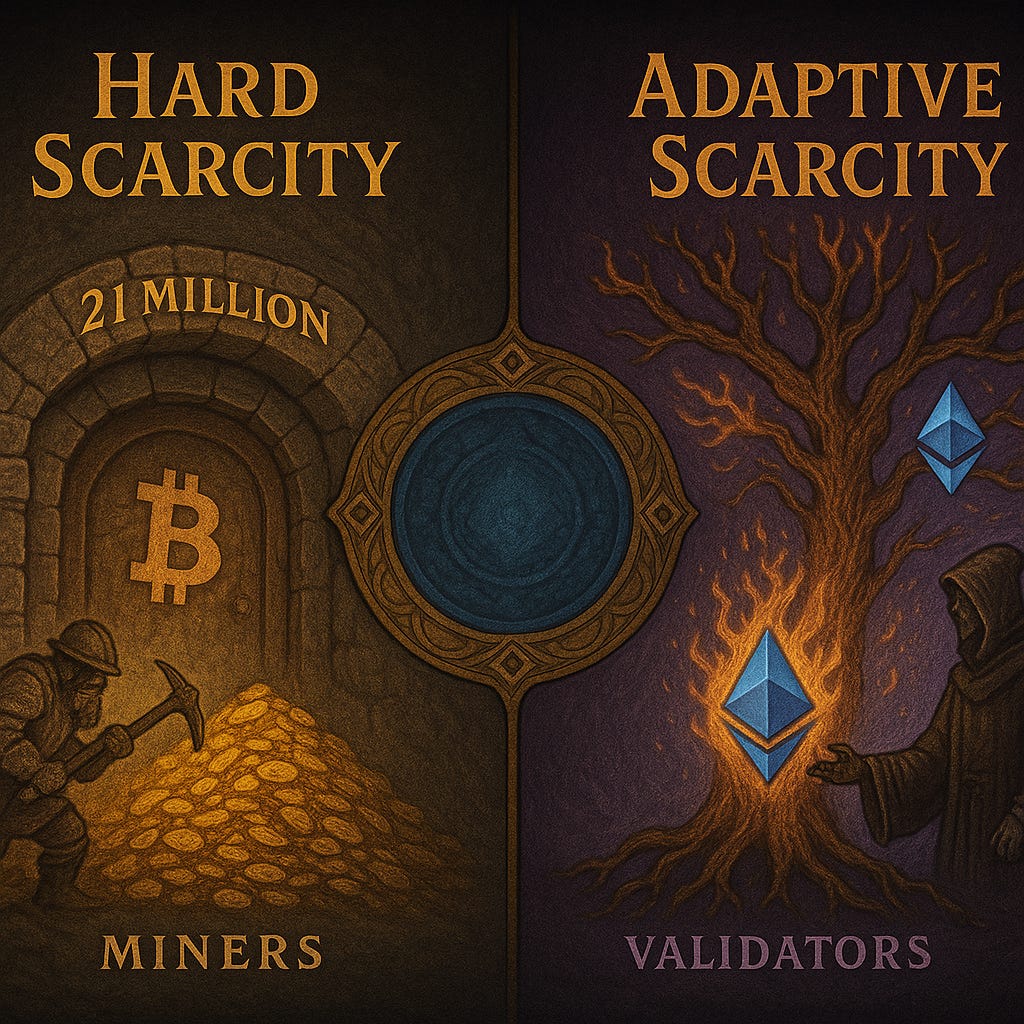
Bitcoin: Hard Scarcity
Bitcoin chose the path of absolute scarcity. It was designed as digital gold, with monetary rules locked in code from the start.
Fixed Supply: Maximum of 21 million coins. While not all are mined yet, the eventual total is predetermined.
Mild Inflation Until Maturity: New coins are issued through mining. This means Bitcoin is technically inflationary today, but the issuance rate halves about every four years and converges to zero by around 2140.
Predictable Issuance: Everyone knows the schedule. The next halving in 2028 is already anticipated.
Miner Rewards: Miners are paid through block rewards and transaction fees. There is no burn mechanism; all fees and issuance go directly to them.
This design, a hard-coded cap plus a declining issuance schedule, makes Bitcoin a digital fortress of scarcity. Its supply is rigid, transparent, and credible.
For investors, that is powerful. Bitcoin does not promise yield, dividends, or applications. It promises something more fundamental: scarcity itself. That is why it has become the benchmark “hard money” of the digital age.
Equity Analogy:
Bitcoin is like a company that has already issued all of its shares and will never authorize new ones. There is no dilution, no buybacks, and no policy changes. Shareholders can be absolutely certain their stake will never be watered down.
Ethereum: Adaptive Scarcity
Ethereum took a different path. It was not designed as digital gold, but as a programmable blockchain capable of running smart contracts, decentralized applications, and financial systems. Its monetary design reflects that mission.
No Fixed Cap: Ethereum does not have a maximum supply written into code.
Gas Fees (EIP-1559): Every transaction requires gas. Since the London upgrade, this is split into two parts:
Base Fee: Set automatically by the protocol. It rises when blocks are congested and falls when demand is low. The base fee is always burned, permanently removing ETH from circulation.
Tip (Priority Fee): An optional extra paid by users to speed up confirmations. Tips go directly to validators.
Validator Rewards: Validators earn newly issued ETH for securing the network and also collect tips from users. Only the base fee is destroyed.
Proof-of-Stake Dynamics: To validate, ETH must be staked. Staked ETH is locked and illiquid, which reduces circulating supply.
The outcome is a system that expands and contracts depending on usage.
When demand is low, base fees are minimal, little ETH is burned, validator rewards dominate, and supply grows.
When demand is high, base fees spike, more ETH is burned, and sometimes burns exceed issuance, shrinking supply.
Ethereum’s scarcity is therefore adaptive. It behaves like a living system that breathes: inflating when activity slows to keep validators incentivized, and deflating when activity surges as burns cancel out issuance.
For holders, this makes Ethereum fundamentally different from Bitcoin. Bitcoin enforces scarcity by rule. Ethereum creates scarcity by use. Its value does not rest on a hard cap, but on the economic vitality of the network itself.
Equity Analogy:
Ethereum is like a company that issues new shares during slow business to pay employees and keep operations running, but buys back shares aggressively when revenues surge. Its policy is adaptive, aiming to balance long-term stability with growth.
Or in one line:
“Bitcoin is like a firm that never dilutes or buys back shares. Ethereum is like a firm that issues when activity slows and buys back when activity surges, keeping the system in balance”.
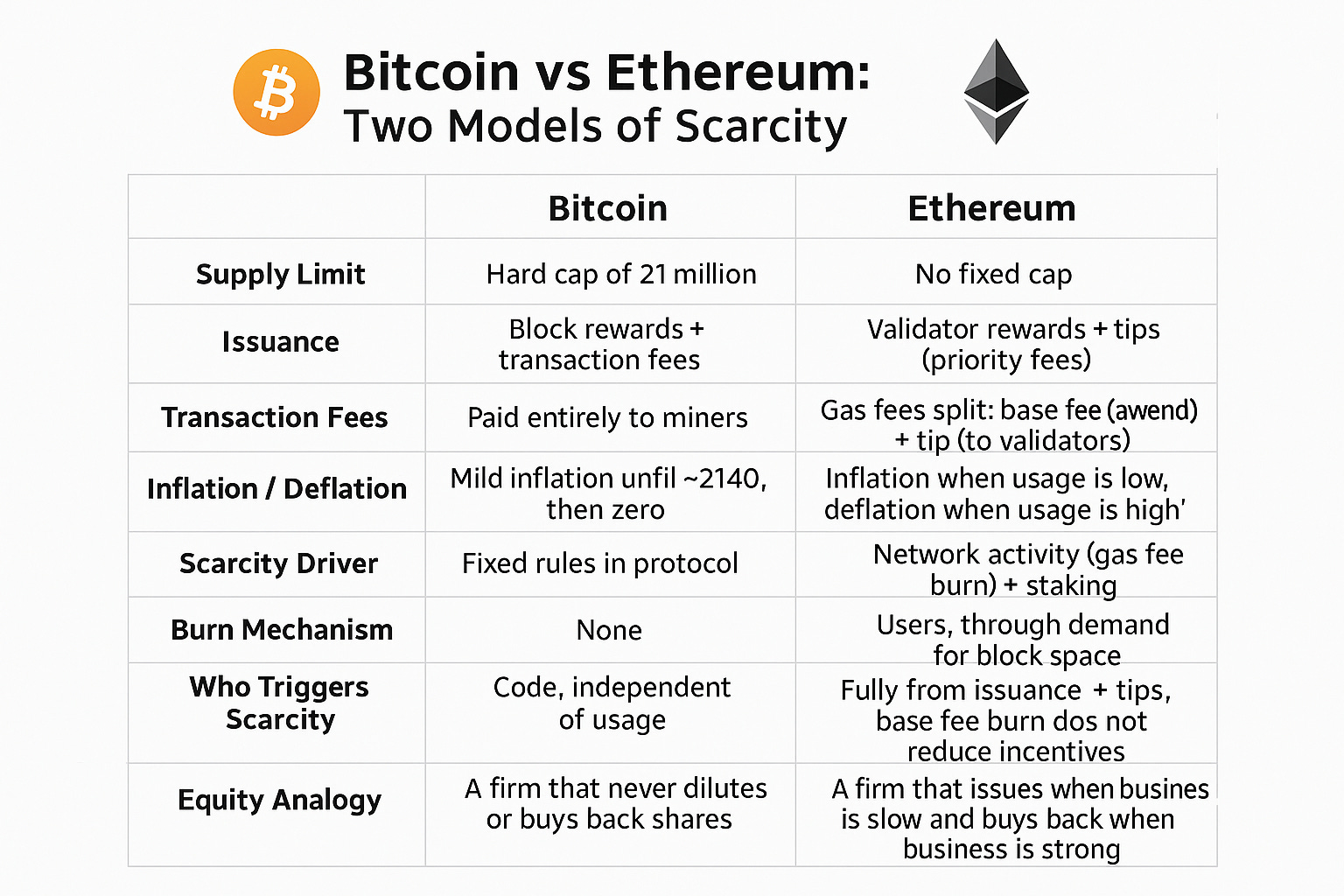
The Scarcity Lens
Through the lens of scarcity, the contrast is fundamental:
Bitcoin’s scarcity is exogenous: fixed by code, capped at 21 million, and independent of demand. Its value flows from the credibility of its rules.
Ethereum’s scarcity is endogenous: flexible, tied to usage, expanding when demand is low and contracting when demand is high. Its value flows from the credibility of its adaptive burn and staking mechanisms.
Traditional finance ties value to discounted cash flows. Crypto flips that script: value can come directly from scarcity, whether enforced by code or by economic feedback loops.
Scarcity can be imposed like a rulebook or emerge like a living organism. Bitcoin chose the former. Ethereum chose the latter.
Conclusion
Bitcoin and Ethereum are not substitutes; they are complements. One represents hard scarcity, the other adaptive scarcity.
Together, they demonstrate that scarcity itself, whether hard or adaptive, is the core innovation.
The next time someone calls Ethereum “inflationary,” remember this: it burns coins. And in doing so, it proves that scarcity comes in more than one form.