
The Vibe Coding Illusion and the SaaS-Pocalypse
Why the death of software is wildly exaggerated, and who actually captures the trillion-dollar compute windfall

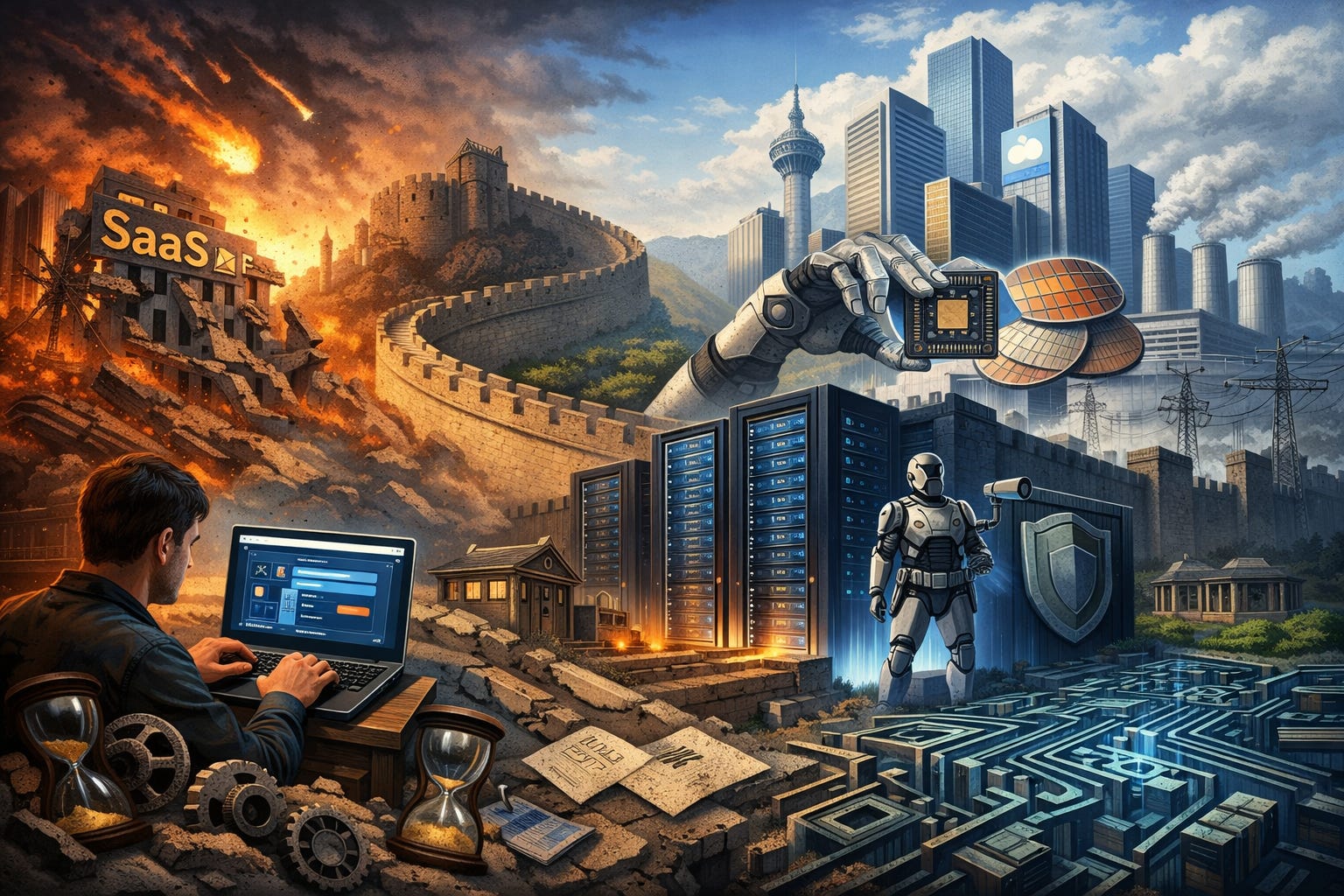
There is a specific genre of video currently dominating the tech landscape. In these clips, a user types a few lines of plain English into an AI prompt, presses enter, and watches a fully functional web application spring to life in seconds.
The first time you see it, it feels like a magic trick. The second time, it starts to feel like a business model breaking.
They call it “vibe coding.” The narrative accompanying these videos is borderline apocalyptic for traditional tech: software engineering is obsolete, anyone can code, and every company on earth will soon fire their vendors to build their own custom tools for pennies. This theory suggests that the $300 billion Software-as-a-Service (SaaS) industry is about to collapse under the weight of infinite, free, AI-generated applications. The “SaaS-pocalypse” is the term of the hour.
Meanwhile, on the other side of the market, investors are agonizing over the hyperscalers: Amazon, Microsoft, and Google. Wall Street is looking at their gargantuan, multi-billion-dollar AI capital expenditures and panicking. The fear is that this infrastructure will never yield a return, especially as dirt-cheap, highly capable Chinese models flood the global market and drive the cost of intelligence to zero.
Both of these narratives are incredibly loud right now.
Both of them fundamentally misunderstand where scarcity is migrating.
To understand why, we need to zoom out past the user interface and identify where the actual bottlenecks are forming. When we track how value moves from digital outputs down to physical infrastructure and legal frameworks, we can see that the death of SaaS is wildly exaggerated. In reality, the hyperscalers are not digging their own graves; they are pouring the concrete for an inescapable monopoly.
Let’s have a look.
The Syntax Illusion
The first flaw in the “SaaS-pocalypse” narrative is the conflation of writing code with systems engineering.
Vibe coding is not magic; it is simply the commoditization of syntax. Yes, generating a sleek User Interface (UI), which refers to the visual layout and buttons we interact with, is now trivial. But enterprise software is not a simplistic UI wrapper. It is a multi-layered, highly fortified beast.
When a Fortune 500 company buys a SaaS product, they are not just buying a button that does a thing. They are buying Role-Based Access Control (RBAC) to manage who sees what data. They are buying Security and Organization Controls (SOC 2) compliance, the rigorous industry standard for security and data privacy that proves a company manages customer data safely. They are buying encrypted database migrations, integration with twenty-year-old legacy mainframes, and liability protection.
To build that via “vibe coding” requires immense engineering training and hyper-precise, architectural-level specification. AI can write the functions, but it cannot organically generate institutional trust. Vibe coding at the base level cannot achieve the necessary functionalities of enterprise software unless it is orchestrated by highly skilled engineers working at a much higher layer of abstraction.
The Maintenance Trap
This brings us to the classic business school dilemma: to make or to buy?
The utopian AI narrative assumes that because building a custom application is suddenly cheap, every company will choose to make it. This ignores the darkest reality of software: code is not an asset. Code is a liability.
The hidden cost of software is rarely the initial build; it is the maintenance. Application Programming Interfaces (APIs) deprecate. Security vulnerabilities are discovered. Underlying databases need patching. If a mid-sized logistics company uses AI to “vibe code” its own custom CRM (Customer Relationship Management system), it now owns the liability of maintaining that software forever.
Companies do not pay SaaS margins just to get software; they pay those margins to outsource the operational headache of keeping it alive. For the vast majority of businesses, it will always be cheaper and structurally sounder to buy a managed solution than to harbor an internal team of engineers to maintain bespoke, AI-generated technical debt.
SaaS companies whose entire value proposition was just a slightly better User Experience? Yes, their scarcity has vanished. They are dead. But deep, workflow-integrated SaaS is not going anywhere.
Heads I Win, Tails You Lose
Let us assume, for a moment, that the SaaS-pocalypse happens exactly as the tech timeline predicts. Millions of companies fire their vendors, vibe-code their own agents, and run highly customized AI models to manage their businesses.
Where do those millions of custom AI agents live?
In the cloud.
Now, let us assume the opposite scenario, which I believe is the reality. SaaS companies do not collapse; instead, they deeply integrate AI into their existing, compliant platforms, making their software heavier, smarter, and infinitely more compute-intensive.
Where does that compute happen?
In the cloud.
This is the classic migration of economic rent. Value is rapidly bleeding out of the capability layer, the human know-how of writing basic code, and pooling directly into the infrastructure layer: the data centers, grid capacity, and silicon.
Hyperscalers are not building speculative products; they are capturing the foundational bottlenecks of the new economy. Whether the enterprise software of the future is bought or built, the hyperscalers collect the toll.
The Invisible Moat
But what about the Chinese models? This is the final bearish argument. If highly capable AI models from China are available globally for fractions of a penny, won’t that destroy the pricing power of Western tech giants?
If intelligence were purely a digital commodity, the answer would be yes. But scarcity does not exist in a vacuum. It is bound by jurisdictional and institutional constraints.
A Western multinational bank, a healthcare provider, or a defense contractor cannot legally, structurally, or politically route its proprietary, highly regulated data through a server cluster in Shenzhen, no matter how cheap the inference is. Data residency laws, intellectual property protections, and national security directives form an invisible, impenetrable moat around Western data.
These restrictions guarantee the Western hyperscalers a captive, high-margin clientele. The competition from cheaper foreign models will force Western models to get better, but it will not break the fundamental bottleneck of institutional compliance.
The Full-Stack Monopoly
There is a final, reinforcing argument for the hyperscalers that many are missing. They are not just the landlords of the AI era; they are also its most defensible tenants.
Most people separate “Cloud Infrastructure” from “SaaS,” but for the giants, this line has dissolved. When Microsoft or Google deploys an AI feature within their productivity suites, they do not pay the same “compute tax” that a third-party startup must pay. They own the chips, the power, and the application. This vertical integration allows them to capture the entire value chain.
Furthermore, their SaaS products act as the ultimate inlet for infrastructure lock-in. Once a global enterprise trusts a hyperscaler to manage its primary workflows, the institutional barrier to using that same hyperscaler for its broader AI compute becomes insurmountable. They have created a compounding scarcity where they own the ground, the building, and the keys to the front door.
Where I Stand
The market is currently mispricing the structural reality of the AI transition. It is assuming maximum disruption at the application layer and minimum return at the infrastructure layer. The physics of scarcity suggest the exact opposite.
Avoid the thin wrappers. Any SaaS company whose only moat was translating database queries into a pretty dashboard has lost its scarcity.
Buy the bottlenecks. Hyperscalers are enduring a brutal capital cycle, but they are securing the foundational layer of the next decade of economic output. Their spending is a feature, not a bug.
Deep SaaS survives. Companies that manage compliance, security, and complex multi-system workflows will simply use AI to widen their margins. The market will continue to pay them to absorb technical liability.
The ability to generate code has become abundant. But the energy to run it, the infrastructure to house it, and the legal frameworks to secure it have never been more scarce.
Invest where the constraints are binding.
🙏 If this kind of analysis is useful to you, subscribing ensures you don’t miss the next piece. Likes help others find it.
About Scarcity Thinker
Most investors chase what is obvious. Scarcity Thinker looks for what is structurally constrained, mispriced, or overlooked. Metals, equities, crypto, and fixed income when the thesis is there. No asset class religion. No hype. New pieces every Tuesday and Friday.
This is not financial advice. These are my personal views and positions. Do your own research. The world is genuinely uncertain right now, which, if you have read this far, is precisely the point.
In the past years internet speed and computing power have increased exponentially, however webpages instead of becoming faster to load they became heavier. More capacity translated into more innovation. Moreover there are many portals where you can build your own webpage without coding. This has not reduced the need for IT-skilled people or marketing specialists.
AI is going to further increase the need for software, not eliminate it.
First, AI lowers the barrier to building digital products. When more people can create software, the total amount of software increases, not decreases. Just as website builders led to millions of new websites rather than fewer developers, AI will likely lead to an explosion of applications, tools, and micro-SaaS products that still require infrastructure, integrations, monitoring, and management.
Second, AI systems themselves are software services. Companies will need platforms for model orchestration, data pipelines, evaluation, security, compliance, and workflow automation. This means new layers of SaaS: AI copilots, data platforms, observability tools, agent frameworks, vertical AI applications, and integration platforms.
Third, when technology becomes easier to build, competition increases. This raises the importance of distribution, branding, analytics, and customer management. In practice, that means more demand for SaaS tools such as CRM, marketing automation, analytics, product analytics, and collaboration platforms.
Finally, as organizations adopt AI, workflows become more complex rather than simpler. Companies will need systems that coordinate humans, AI agents, and data across departments. This coordination layer is precisely what SaaS platforms provide.
For these reasons, AI may shift the type of SaaS that is valuable, but it is unlikely to eliminate the category. Historically, every major increase in computing capability has expanded the software ecosystem rather than shrinking it, and AI is likely to follow the same pattern.
I'm also skeptical of the SAAS-pocalypse. A vibe-coded Lovable app spun out on a weekend is not going to replace a CRM for an SMB even if it is infinitely cheaper, they are outsourcing the maintenance and security so they can focus on their edge. You've got me thinking on cloud infrastructure again, so many roads seem to lead to this bottleneck. Great piece Agisilaos.